Zohran Mamdani – A Torchbearer and a Charismatic Leader
Zohran Mamdani, assumed office as the city’s youngest mayor in a century, while also becoming its first Muslim and first South Asian mayor
By Shahid Khan, New York
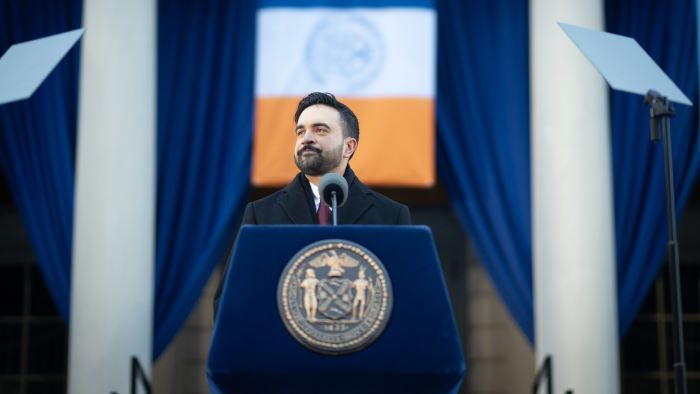
January 1, 2026 marked a significant moment in the political history of New York City. Zohran Mamdani, a 34-year-old immigrant from Uganda, assumed office as the city’s youngest mayor in a century, while also becoming its first Muslim and first South Asian mayor.
He was sworn in alongside his wife, taking the oath of office on the Holy Qur’an held by her and administered by his mentor, Bernie Sanders—a solemn and deeply symbolic moment reflecting the convergence of faith, family, and public service.
After taking the oath, Mayor Mamdani addressed the assembled audience with a message that was both reflective and forward-looking. He expressed gratitude to the people of New York City for their trust and emphasized his deep sense of responsibility toward all residents, regardless of background or belief.
He spoke of unity, inclusion, and shared civic values, underscoring the idea that the city’s strength lies in its diversity and collective resilience. Acknowledging the challenges facing New Yorkers—from affordability and public safety to dignity in work and access to opportunity—he called for renewed civic engagement and principled governance. His speech struck a tone of humility and resolve, signaling a commitment to serve with integrity, compassion, and accountability as he begins his term in office.
The moment marked not only the formal beginning of his term through 2026, but also a powerful affirmation of America’s pluralism—where faith, identity, and public service can coexist openly. Mamdani’s ascent reflects a city and a generation redefining leadership, inclusion, and what representation truly looks like in the heart of American democracy.
His becoming mayor of New York City—often described as the capital of the world—powerfully validates the American dream: that talent, hard work, and genuine passion can overcome barriers of origin, faith, and background. It sends a clear message that opportunity in America is not reserved for a select few, and that determination and merit can still break through entrenched power structures.
Mamdani launched his campaign at the grassroots level, placing particular emphasis on engaging young voters and first-time participants in the political process. He made strategic use of social media platforms, sharing short, accessible videos in multiple languages that resonated with New York City’s diverse communities. Through direct engagement with minority groups and sustained outreach to interfaith communities, he built a broad and vibrant coalition that ultimately played a decisive role in his electoral success.
Beyond strategy, Mamdani’s personal demeanor significantly enhanced his appeal. Known for his warmth and approachability, he consistently greeted supporters with a genuine smile that fostered trust and familiarity. His humility and kindness set him apart, while his skill as an orator—marked by clear, accessible, and compelling language—allowed him to connect emotionally as well as intellectually with diverse audiences.
His campaign was grounded in a policy-oriented framework that prioritized the concrete challenges facing working-class and fixed-income populations. Central to his platform were proposals for rent stabilization, expanded affordable housing, increases in the minimum wage, free child care, fare-free and faster public transportation, and the development of subsidized supermarkets to address food insecurity. By emphasizing structural economic conditions rather than symbolic appeals, he advanced a governance-centered agenda focused on equity, affordability, and social protection.
Throughout the campaign, Mamdani faced a sustained and malicious smear effort. It included unfounded allegations that he sought to impose Shariah law in New York City, portrayals of him as a communist, false associations with Hamas, and even calls for the revocation of his citizenship. He was routinely labeled a “jihadi,” subjected to ideological caricatures, and exposed to multiple death threats. These efforts ultimately failed.
Voters rejected fear-based narratives and political misinformation, affirming democratic judgment by choosing leadership over falsehood, integrity over intimidation, and civic hope over politics rooted in animus.
Mamdani set two historic records: first, by securing the highest number of votes in the Democratic primary and decisively defeating Andrew Cuomo; and second, by repeating that achievement in the general election, once again winning with the highest vote total. Together, these victories underscore the breadth of his support and mark a rare electoral accomplishment in New York City politics.
He demonstrated exceptional strength among younger voters, capturing 78 percent of the vote among those under 30 and 66 percent among voters aged 30 to 44. Notably, he also secured the support of nearly two-thirds of Jewish voters under the age of 40. These results point to a broader generational realignment, driven by his emphasis on economic justice, social inclusion, and policy-driven governance.
Mamdani’s victory is a powerful reminder that determination, confidence, and authenticity can overcome even deeply entrenched forces. He challenged the political establishment and wealthy elites head-on and prevailed not through money or influence, but through talent, courage, and conviction. It was a campaign rooted in people rather than privilege—a true grassroots victory.
He now occupies a rare space of expectation and symbolism, one that carries both promise and pressure. History reminds us that the journey from hope to governance is often the most demanding test of leadership.
The responsibility before him is immense. Campaign promises now meet the realities of governing, where difficult decisions and trade-offs are unavoidable. Yet he enters this phase with youth, energy, and clarity of purpose that inspire confidence.
Mamdani is not a short-term phenomenon, but a long-distance runner with a long road ahead. Leadership is built over time through resilience, learning, and the willingness to adapt. If he remains grounded in his values and attentive to the people who placed their trust in him, he has every opportunity to transform hope into lasting governance.
The ultimate measure of his significance does not rest solely on policy outcomes. What already matters is the political opening he has created. By existing as a credible, unapologetic Muslim candidate in a space long considered inaccessible, he has expanded the boundaries of what feels possible.
He has offered a younger generation something tangible to believe in—something to vote for rather than merely against. In that sense, his victory is not only electoral, but cultural and generational.
Mamdani has become a powerful role model and a torchbearer for young Muslims, helping to create space where little existed before. That space now carries responsibility.
His journey makes clear that progress demands discipline, resilience, and sustained effort. Dreams are not handed out; they are earned through perseverance and integrity. His story offers both inspiration and challenge, with a message that is simple but profound: believe boldly, work relentlessly, and never underestimate what is possible.